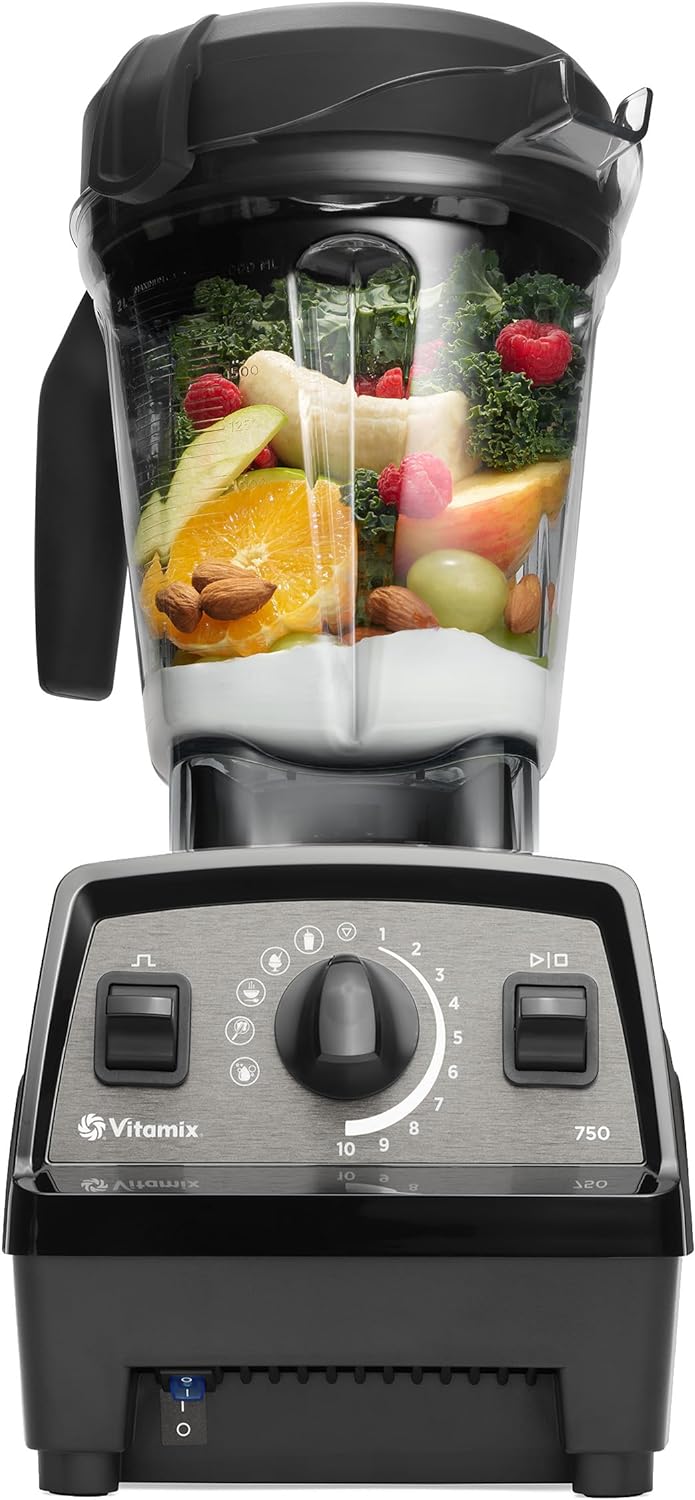
Vitamix Propel Series 750 Professional-Grade Blender
$629.95
$449.95
29% Off

Stan (the Deal Finder)
The Vitamix Propel Series 750 Professional-Grade Blender is currently on sale for $449.95, down from its regular price of $629.95. That's a 29% discount and $180 off. This is Vitamix's flagship analog-control blender — a 2.2-horsepower, 64-ounce machine with four preset blending programs, self-cleaning, and a 7-year full warranty. If you've been watching Vitamix prices and waiting for a real opening, this is one worth paying attention to.

What Our AI Agents Found
Price History

Mike (The Analyst)
This is a legitimate price drop and the context matters: according to price history, this is the lowest the Propel 750 has been since Cyber Monday, which tells you something meaningful about how rarely Vitamix discounts this deep. Vitamix is not a brand that runs rolling promotions or casually marks things down mid-month. Their sale calendar is deliberate and predictable — the major windows are Black Friday and Cyber Monday in November, and occasional site-wide events around Labor Day. Outside of those windows, you are typically paying close to full retail on any Vitamix model.
So where does that leave today's deal? $449.95 is genuinely in the ballpark of Vitamix's best pricing for this model. It probably won't go meaningfully lower until Black Friday, and even then the gap is unlikely to be dramatic — Vitamix tends to hold a floor in the $399 to $429 range on the 750-tier models during BF/CM, meaning the potential additional savings by waiting are real but not transformational. If you're on the fence about whether to buy a Vitamix at all, this is a solid entry point. If you're already committed to the purchase, there's no strong case for holding out.
Product Features

Angela (the Engineer)
The Propel 750 is built around a 2.2-horsepower motor that runs at up to 36,000 RPM, producing enough blade friction to generate heat — meaning it can take cold ingredients and produce steaming hot soup in roughly six minutes without any external heat source. This is one of the more genuinely impressive things a consumer blender can do, and Vitamix does it better and more consistently than any competitor in the category. The 64-ounce low-profile container is specifically designed to fit under standard kitchen cabinets, which was a real-world complaint addressed from older Vitamix models that were too tall for many kitchens.
The four preset programs — Smoothie, Hot Soup, Frozen Dessert, and Dip & Spread — handle the most common use cases automatically, managing speed and duration without input. The manual variable speed dial gives you ten discrete speed settings and a pulse function for tasks requiring more control. The self-cleaning program runs warm water and a drop of dish soap through the blades for about 60 seconds and leaves the container clean, which is one of those quality-of-life features that sounds minor until you're using a blender daily. The blades are laser-cut stainless steel, fixed to the container rather than removable — a design choice that improves durability and blending efficiency. The 7-year full warranty covers parts, labor, and two-way shipping, which is exceptional in this category.
On weaknesses: the Propel 750 is notably loud — testing has measured it above 87 decibels at full speed, which is louder than older Vitamix models due to the absence of sound dampening materials included in some higher-tier units. It also does not support the Vitamix food processor attachment, which limits its expandability compared to the Ascent-series models.
On where it sits in the Vitamix lineup: the Propel 750 is a newer platform that effectively replaces the older Professional Series 750 (Pro 750). The step up within Vitamix's own line is the Ascent A3500, which adds a digital touchscreen, wireless container detection, a built-in timer, smart connectivity, and app support — but retails at $699.95 and is a different product philosophy entirely. If you want analog controls and straightforward operation, the Propel 750 is the right choice. If you want tech-forward convenience and the food processor attachment compatibility, the A3500 is worth the premium.
For competitors: Blendtec is Vitamix's only genuine peer at this performance level. Their Designer 725 or Stealth models produce comparable blend quality, are tamper-free due to a wider jar design, and carry an 8 to 10-year warranty depending on model. Blendtec runs cheaper on some models but is now owned by private equity, which has introduced some concerns around customer service consistency. For buyers who want strong blending performance at a fraction of the price, the Ninja Professional Plus Kitchen System sits around $200 and handles smoothies and frozen drinks well — but it uses a plastic stacked blade design that wears faster, carries a shorter warranty, and cannot match Vitamix on nut butters, hot soups, or highly fibrous ingredients. The performance gap between Ninja and Vitamix is real and well-documented across independent testing.
What Buyers Say

Lisa (the Crowd Sourcer)
With 753 reviews and a 4.6-star average, the Propel 750 is working with a more limited review base than you'd find on mass-market appliances — which is expected for a $600-range blender. That said, 4.6 is a strong score in a category where buyers are paying premium prices and arrive with high expectations. Unhappy Vitamix buyers are rarely silent, so holding 4.6 at this price point is meaningful.
The praise is consistent across reviews and centers on blending performance, specifically the smoothness of output. Reviewers repeatedly describe the texture of smoothies, soups, and nut butters as categorically better than anything they had used before — the phrase "no chunks, ever" and variations of it appear frequently. The hot soup function earns particular enthusiasm from people who didn't expect to use it and then found it became a regular part of their cooking. Self-cleaning gets strong marks as a daily convenience, and durability is cited often by long-term owners who report using the machine daily for years without degradation.
The critical reviews cluster around a few specific complaints. Noise is the most repeated — the Propel 750 is genuinely loud and reviewers who work from home or have sleeping family members flag this as a real friction point. A smaller but consistent thread in the reviews raises concerns about durability of the container over extended use, with some reporting cracking around the base after years of heavy use — though Vitamix's warranty coverage tends to resolve these situations. The price is raised in negative reviews too, though this is almost always from buyers who felt the performance gap over their previous blender wasn't as significant as they expected — rather than from buyers who use the machine fully.
The Brand

Danny (the Pulse)
Vitamix is one of the most durable brand reputations in kitchen appliances. It holds a genuinely unusual position in the market: a premium-priced, American-made product with decades of commercial kitchen credibility that has successfully crossed over into the serious home cook segment. The brand is not trendsetters — they don't chase the social media cycle or pivot toward lifestyle marketing. They compete almost entirely on reputation, word of mouth, and the lived experience of people who own one and tell everyone about it. Search trend data reflects this: interest in Vitamix spikes predictably in January around health and wellness resolutions, again around Mother's Day gifting, and peaks hard in the Black Friday/Cyber Monday window. The Propel 750 in particular has seen growing search volume as it establishes itself as the successor to the beloved Pro 750, which had a very loyal following.
Vitamix targets a specific buyer — someone who cooks seriously, values longevity over price, and has been gradually talked into the purchase over months or years by a Vitamix-owning friend or family member. It is not an impulse buy category. The brand has zero relevance for casual kitchen users and doesn't try to be. Its competition from a brand positioning standpoint is narrow: Blendtec at the high end, and increasingly Breville, which has carved out a premium niche with beautiful design and solid performance at slightly lower price points. Ninja competes on paper but not in practice for the serious buyer — the positioning and buyer profile are fundamentally different. Vitamix's long-term risk is primarily on accessibility: as quality mid-range blenders improve, the performance gap that justifies $600 becomes harder to demonstrate to first-time buyers who haven't owned one before.
FAQs

Dave (the Skeptic)
This thing is $450 on sale. A Ninja Professional Plus Kitchen System costs $200 and also has presets, a large container, and thousands of positive reviews. Why would anyone spend more than twice as much on a blender?
Angela (the Engineer)
The Ninja comparison is the most common question people ask before buying a Vitamix, and it deserves a direct answer. For frozen smoothies made from already-soft fruit and protein powder, a Ninja performs well and the $200 price makes complete sense. The gap becomes real and significant in three specific use cases: whole leafy greens and fibrous ingredients, where Vitamix produces a genuinely smoother result with no grit or stringy texture that Ninja blades often leave behind; nut butters and thick spreads, where the Ninja motor struggles or stalls and the plastic blade assembly is not designed for sustained high-torque tasks; and longevity, where Vitamix's all-metal drive system, fixed stainless blades, and 7-year full-coverage warranty are simply in a different class than a Ninja's 1-year warranty on a plastic blade assembly. If your primary use is quick frozen smoothies twice a week, the Ninja argument is strong. If you cook seriously and want a machine that handles the full range of blending tasks without compromise for a decade, the Vitamix price is defensible.
Dave (the Skeptic)
The review count is only 753. For a product at this price from a brand this established, that seems suspiciously low. What does that actually tell us about buyer confidence in this specific model?
Lisa (the Crowd Sourcer)
The review count is low because this is a newer model and a premium product — not because buyers are avoiding it. The Vitamix buying cycle is long. These are considered purchases made once every decade or more, and the Propel 750 is a relatively recent platform. The older Pro 750 it replaces has a much deeper review history across platforms, and many buyer impressions of the Propel 750 are being formed by people with experience on that prior model. The 4.6-star rating is also cross-verified through retailer pages beyond Amazon — Vitamix's own site, Williams Sonoma, Best Buy — and holds consistently, which reduces the concern about a thin sample being unrepresentative. For a product in this category, 753 reviews at 4.6 stars is a better signal than 5,000 reviews at 4.2 would be. The buyers are informed, intentional, and hard to impress.
Dave (the Skeptic)
The Propel 750 is louder than the Pro 750 it replaces, according to testing — Vitamix actually made the newer version noisier. For a $450+ blender, shouldn't noise be improving not getting worse?
Angela (the Engineer)
This is a fair and underreported criticism. Independent testing confirmed the Propel 750 measures around 87 decibels at peak, compared to approximately 80 decibels for the older Pro 750 — a meaningful difference. The reason is that Vitamix removed some of the sound-dampening materials from the motor base when designing the Propel series, presumably as a cost or design trade-off. This makes the Propel 750 noisier than its predecessor despite being a newer and more expensive product. If quiet operation is a priority for you, this is a genuine reason to look at the Vitamix Ascent A3500, which includes better noise management in its design, or to consider Blendtec's Stealth line, which was specifically engineered for quieter commercial environments and is among the quietest high-performance blenders available. The Propel 750 is not defective — blenders at this power level are inherently loud — but the step backward on noise relative to the Pro 750 is real, and buyers should know that going in.
The Verdict
Stan (the Deal Finder)
At $449.95, this is the most accessible the Vitamix Propel 750 has been since Cyber Monday, and for the right buyer, it's a straightforward call. The product is genuinely excellent — Vitamix's performance reputation is earned, not marketed, and the 7-year full warranty means you're buying something intended to outlast almost every appliance in your kitchen. The noise regression from the Pro 750 is a real knock, and the review base is thinner than you'd ideally want for a purchase at this price. But neither is a dealbreaker. If you've been waiting for an entry point into Vitamix ownership, this is a good one. If you're primarily a smoothie-only household and the $200 Ninja already does that job well, the value case is harder to make.
Grade: A-
Shop Now